
Catalytic combustion sensors
Catalytic combustion sensors are classified according to the method employed to measure combustible gas, and they have come to be widely used to prevent methane explosions in coal mines from about 1959. Since then, they have been improved considerably and are now more widely used throughout various industrial sectors as reliable sensors.
- Accuracy and reproducibility are excellent
- Low power consumption allows devices to be more compact
- Hardly affected by ambient temperature and humidity
- The output curve (to just short of the explosion threshold) is almost a straight line
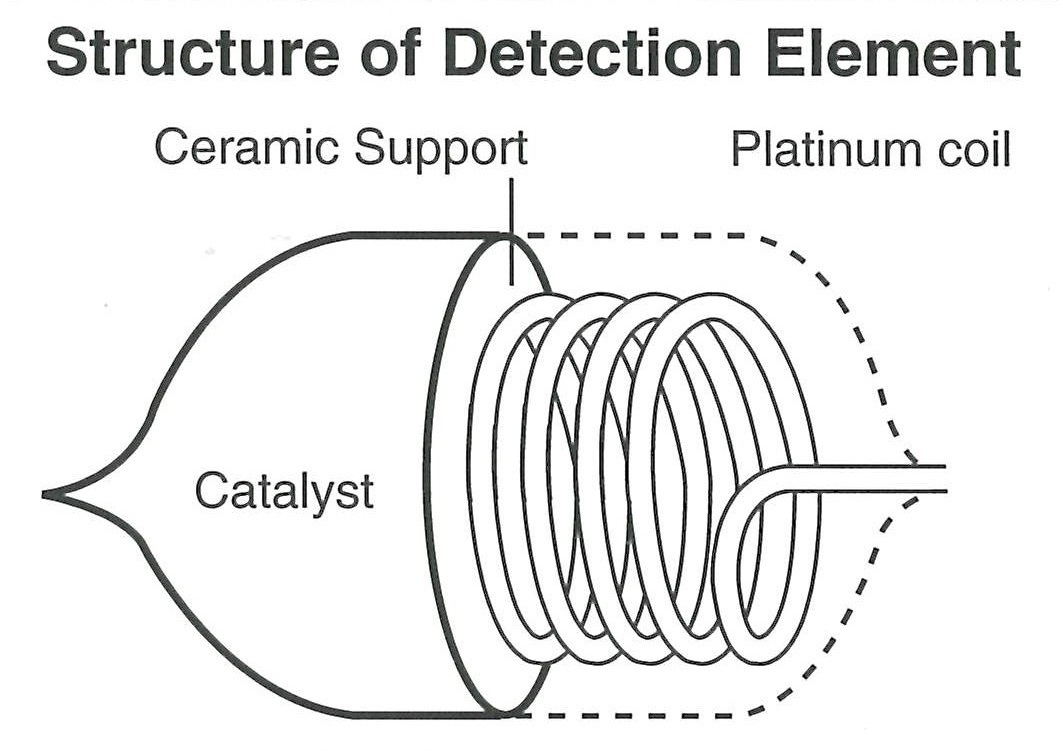
Configuration detector element
The sensor consists of a detector cell and a reference cell. The detector cell basically is a platinum wire coil (φ0.05mm or less)to which the carrier is attached, and it is coated with an oxidization catalyst such as alumina. When the powered sensor is exposed to combustible gas, the gas will burn. The reference cell is essentially an identical platinum coil, that has been treated to prevent combustible gas from igniting upon contact. (Since both cells become extremely hot during use which could ignite the combustible gas, they are enclosed in an explosion-proofed protective sintered metal and stainless steel 200-mesh netting to prevent sparking).
Shipping & Delivery